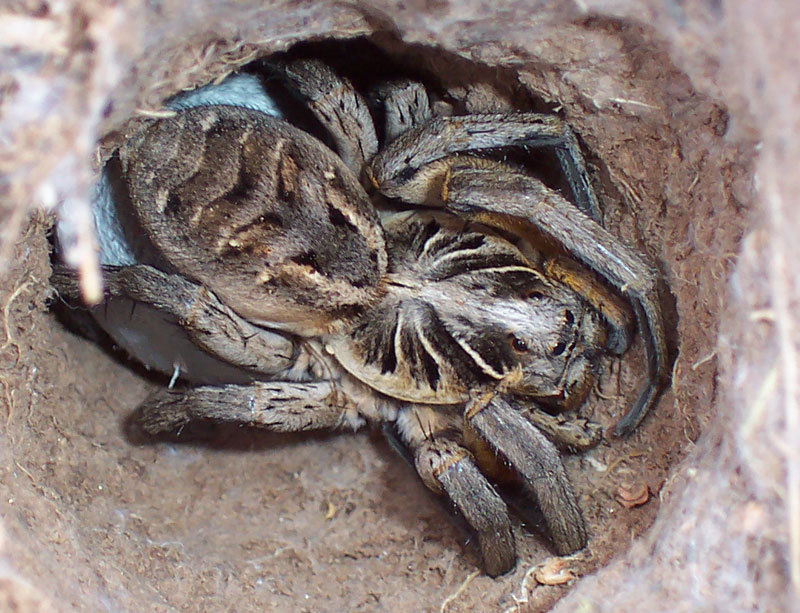
Summary
Wolf spiders are large, fast-moving ground-hunting spiders frequently mistaken for brown recluses because of their brown coloration. Unlike recluses, they have eight eyes in a distinctive three-row pattern, do not build prey-capture webs, and are not medically significant.
Quick answers
- Is Wolf Spider dangerous to humans?
- No. Current evidence does not link wolf spider bites to serious medical outcomes in healthy adults.
- How big is an adult wolf spider?
- Adult female body length is 10–35 mm; males are 8–25 mm. Leg span reaches 25–80 mm.
- Where does Wolf Spider live?
- Ground level - fields, leaf litter, mulch, ground-floor rooms, garages, basements. Frequently invade houses in autumn. Established U.S. populations occur in 1 states.
- What does Wolf Spider eat and when is it active?
- Ground-active insects - crickets, beetles, cockroach nymphs, ants. Active hunters; many species nocturnal but some are diurnal. Do not ambush from webs.
Identification
- Large robust body (10–35 mm) with thick, often hairy legs
- Three-row eye pattern with two large median eyes (definitive)
- Brown, gray, or tan with longitudinal stripes - never with a violin marking
- Female carries egg sac attached to spinnerets; spiderlings ride on the mother's back
- Visible eyeshine at night
- Runs rapidly when disturbed rather than retreating to a web
Morphometrics
| Measurement | Female | Male |
|---|---|---|
| Body length | 10–35 mm | 8–25 mm |
| Leg span | 25–80 mm | - |
| Lifespan | 1–3 years | - |
| Trait | Value |
|---|---|
| Web type | None for prey capture. Many species live in silk-lined burrows; some construct a turret entrance. |
| Eye arrangement | Eight eyes in three rows: four small eyes on the bottom row, two very large median eyes in the middle row, two medium eyes on the top row. Eyeshine is visible at night with a flashlight held near the observer's head. |
| Eggs per sac | 100–365 |
| Egg sacs per year | 1–3 |
Geographic range
Native range: Worldwide except polar regions; common in all 50 U.S. states.
U.S. states with established populations: All 50 U.S. states.
State pages covering Wolf Spider
AlabamaAlaskaArizonaArkansasCaliforniaColoradoConnecticutDelawareFloridaGeorgiaHawaiiIdahoIllinoisIndianaIowaKansasKentuckyLouisianaMaineMarylandMassachusettsMichiganMinnesotaMississippiMissouriMontanaNebraskaNevadaNew HampshireNew JerseyNew MexicoNew YorkNorth CarolinaNorth DakotaOhioOklahomaOregonPennsylvaniaRhode IslandSouth CarolinaSouth DakotaTennesseeTexasUtahVermontVirginiaWashingtonWest VirginiaWisconsinWyoming
Habitat & behavior
Habitat: Ground level - fields, leaf litter, mulch, ground-floor rooms, garages, basements. Frequently invade houses in autumn.
Activity: Active hunters; many species nocturnal but some are diurnal. Do not ambush from webs.
Diet: Ground-active insects - crickets, beetles, cockroach nymphs, ants.
Venom & medical significance
| Venom property | Value |
|---|---|
| Type | Not medically significant |
| LD₅₀ | Not established |
| Note | Bites cause mild local pain only. |
Bite symptoms & first aid
Symptoms
- Sharp local pain comparable to a bee sting
- Minor redness and swelling, resolving within hours
Commonly confused with
- Brown recluse
- Grass spider
- Nursery web spider
- Hobo spider
- Fishing spider
Key facts
- Wolf spiders are the spider most frequently submitted to entomology departments as 'suspected brown recluses' - a 2002 study found wolf spiders accounted for the largest single category of misidentifications. [1]
- Female wolf spiders are unique among spiders in carrying spiderlings on their back for the first week or two after hatching. [2]
Sources
- [1]Wolf Spiders - University of Kentucky Entomology (ENTFACT-628). Accessed 2026-06-14.
- [2]Wolf Spiders - Texas A&M AgriLife Extension. Accessed 2026-06-14.