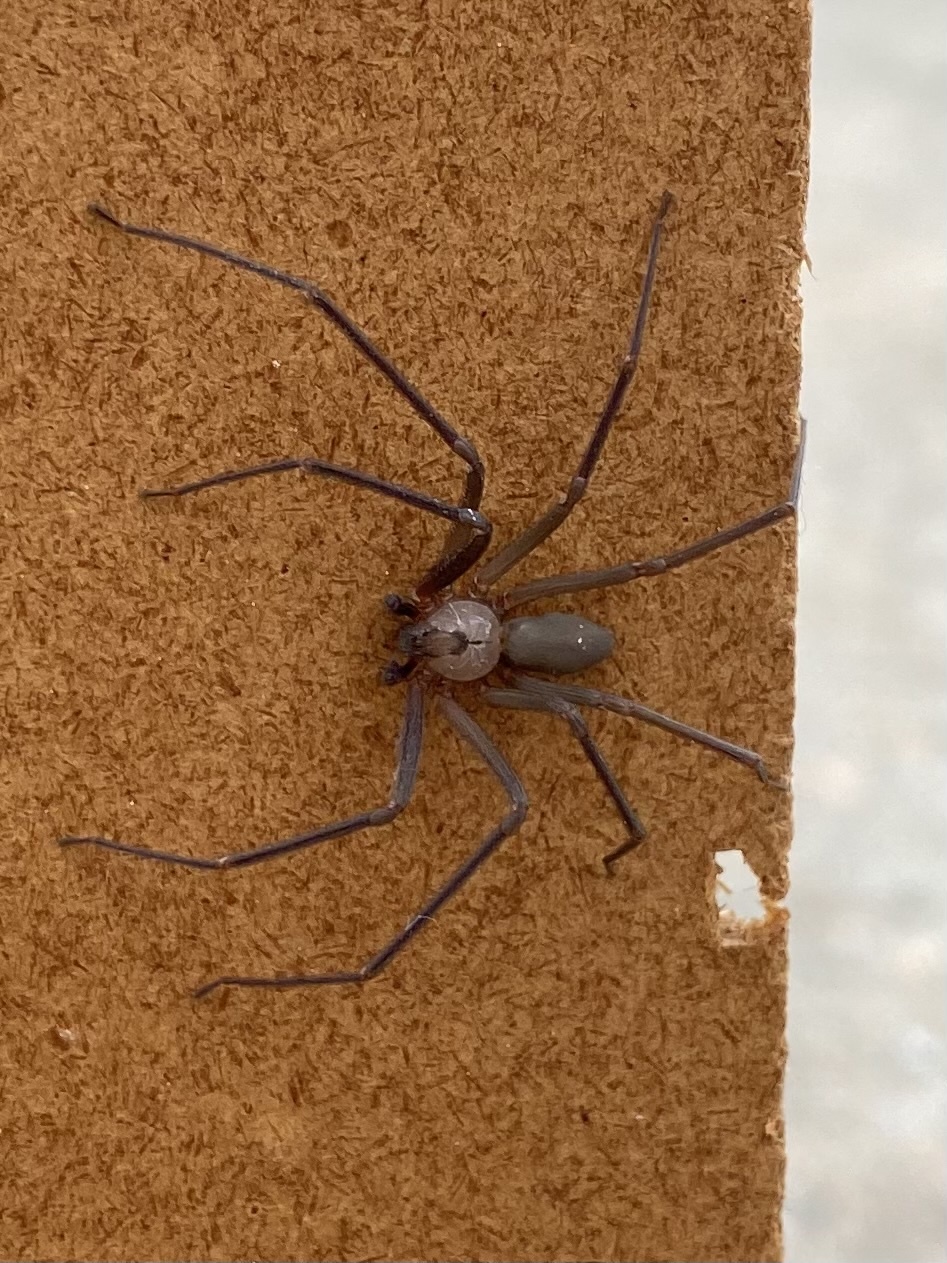
Summary
The most medically significant recluse worldwide. Native to South America and introduced to a few U.S. localities (notably Los Angeles County). Bites are responsible for the majority of confirmed loxoscelism worldwide and have a higher rate of systemic complications than L. reclusa.
Quick answers
- Is Chilean Recluse dangerous to humans?
- Yes. Chilean Recluse is one of the few species in North America whose bite is established as medically significant. Adult-female bites can warrant medical evaluation.
- How big is an adult chilean recluse?
- Adult female body length is 8–15 mm; males are 7–13 mm. Leg span reaches 25–45 mm.
- Where does Chilean Recluse live?
- Undisturbed indoor spaces; basements, attics, storage areas. Established U.S. populations occur in 1 states.
- What does Chilean Recluse eat and when is it active?
- Small insects. Nocturnal hunter.
Identification
- Six eyes in three pairs (definitive for Loxosceles)
- Tan to dark brown, slightly larger than L. reclusa
- Subtle violin marking on cephalothorax
- Body 8–15 mm
Morphometrics
| Measurement | Female | Male |
|---|---|---|
| Body length | 8–15 mm | 7–13 mm |
| Leg span | 25–45 mm | - |
| Lifespan | 2–5 years | - |
| Trait | Value |
|---|---|
| Web type | Loose, irregular sheet retreat - not for prey capture. |
| Eye arrangement | Six eyes in three pairs (sicariid-typical). |
| Eggs per sac | 50–100 |
| Egg sacs per year | 1–5 |
Geographic range
Native range: Native to Chile, Argentina, Peru. Introduced populations in Los Angeles County, California.
U.S. states with established populations: California (introduced, isolated).
State pages covering Chilean Recluse
Habitat & behavior
Habitat: Undisturbed indoor spaces; basements, attics, storage areas.
Activity: Nocturnal hunter.
Diet: Small insects.
Venom & medical significance
| Venom property | Value |
|---|---|
| Type | Cytotoxic (sphingomyelinase D); higher potency than L. reclusa |
| LD₅₀ | Not established |
| Note | Systemic loxoscelism (intravascular hemolysis, kidney injury) occurs in up to 16% of confirmed envenomations - substantially higher than L. reclusa. |
Bite symptoms & first aid
Symptoms
- Local necrosis as in L. reclusa, often more extensive
- Systemic loxoscelism more common: hemolysis, hemoglobinuria, kidney injury
- Pediatric cases carry significant mortality risk in untreated severe envenomation
Commonly confused with
- Brown recluse
- Mediterranean recluse
- Other Loxosceles spp.
Key facts
- Loxosceles laeta is responsible for the majority of confirmed loxoscelism cases worldwide; in Chile, several thousand bites are reported annually. [1]
Sources
- [1]Loxosceles laeta (Chilean Recluse) - University of California, Riverside Spider Research. Accessed 2026-06-14.